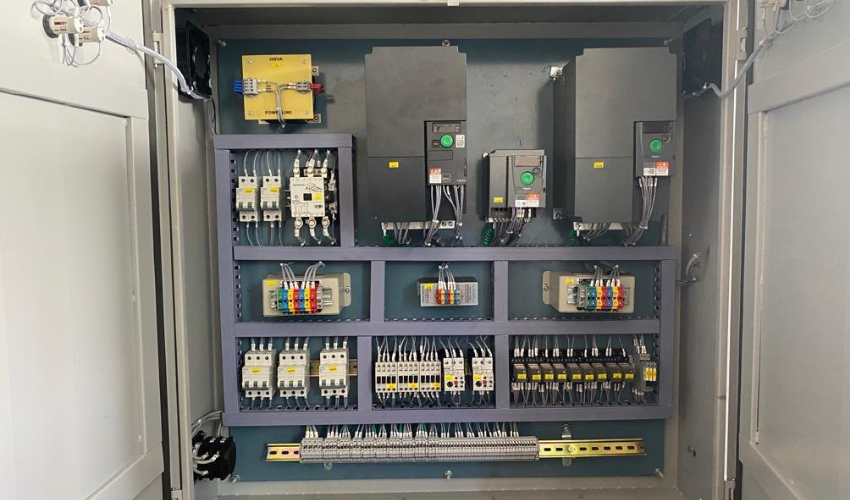
Crane Control Panel
A Crane Control Panel is an essential component used to operate,
monitor, and protect the electrical and mechanical functions of a
crane. It ensures smooth and safe lifting, lowering, and movement
of heavy loads in industrial, construction, and warehouse
applications.
Types of Crane Control Panels
1.Hoist Control Panel
- Controls the lifting and lowering functions of the crane.
Equipped with motor starters, brakes, and overload protection.
2.Travel & Trolley Control Panel
- Manages the horizontal movement of the crane across tracks.
- Includes VFDs (Variable Frequency Drives) for speed control.
3.Bridge Crane Control Panel
- Controls the main bridge movement in overhead cranes.
- Synchronizes motors for smooth and safe operation.
4.Wireless & Remote-Controlled Panels
- Uses radio-frequency (RF) or infrared signals to operate the crane
remotely.
- Enhances safety by allowing operators to maintain a safe distance.
5.Programmable Logic Controller (PLC) Panel
- Provides automation and precise control of crane functions.
- Used in advanced applications requiring synchronization and
monitoring.
Main Components of a Crane Control Panel
1. Power & Protection Components
- Circuit Breakers & Fuses – Protect against short circuits and overloads.
- Overload Relays – Prevent motor overheating.
- Emergency Stop (E-Stop) – Allows immediate shutdown for safety.
2. Motor Control Devices
- Contactors & Starters – Control crane motors for lifting and movement.
- Variable Frequency Drives (VFDs) – Adjust motor speed smoothly for
precise control.
- Braking System (Dynamic & Regenerative Brakes) – Ensures controlled
stopping.
3. Control & Display Units
- Push Buttons & Joysticks – Manual operation of crane movements.
- Human Machine Interface (HMI) & Touchscreen Displays – Provides real time monitoring and control.
- Load Sensors & Limit Switches – Prevent overloads and excessive
movement.
Functions of a Crane Control Panel
- Controls lifting, lowering, and movement of the crane.
- Ensures safe and smooth operation with overload and emergency stop
features.
- Regulates motor speed and torque using VFDs or soft starters.
- Prevents damage through limit switches and braking systems.
- Supports automation with PLC-based control systems.